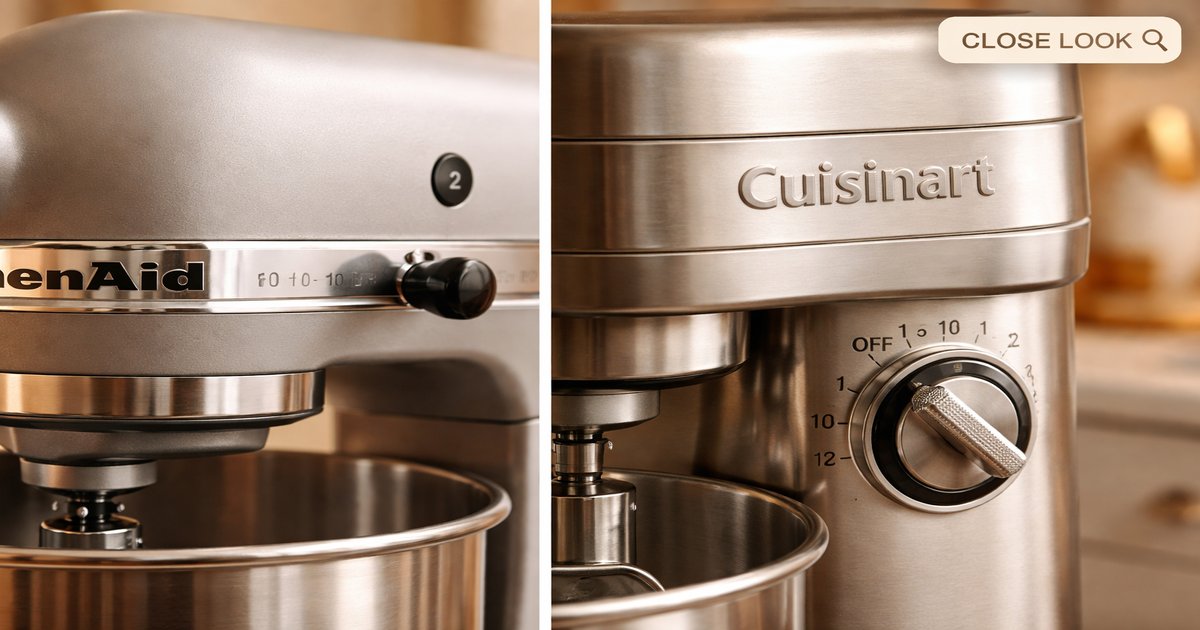
So, you’re in the market for a stand mixer, and you’re stuck between a KitchenAid and a Cuisinart. Maybe you’ve heard your friends rave about the KitchenAid, or perhaps you’ve seen Cuisinart’s competitive pricing and are tempted. Let’s break down these two heavyweights to see which one truly deserves a spot on your countertop.
| Feature | KitchenAid Stand Mixer | Cuisinart Stand Mixer |
|---|---|---|
| Motor Power | 325 Watts | 500 Watts |
| Bowl Capacity | 5 Quarts | 5.5 Quarts |
| Number of Speeds | 10 | 12 |
| Attachments Available | ✓ | ✓ |
| Planetary Mixing Action | ✓ | ✓ |
| Warranty | 1 Year | 3 Years |
✅ kitchenaid stand mixer Pros
- Classic design that complements any kitchen aesthetic.
- Wide array of attachments for versatile use.
- Reliable and consistent performance for most baking needs.
❌ kitchenaid stand mixer Cons
- Higher price point compared to Cuisinart.
- Less powerful motor.
- Heavier and more cumbersome to move.
✅ cuisinart Pros
- More powerful motor handles tough doughs with ease.
- Comes with a longer warranty period.
- Offers more speed settings for precise control.
❌ cuisinart Cons
- Less iconic design might not appeal to everyone.
- Fewer brand-specific attachments available.
- Plastic components feel less durable.
Performance: Power vs. Precision
Cuisinart’s 500-watt motor makes short work of heavy doughs, which is great if you’re into serious bread making. It doesn’t shy away from thick batters or large batches. On the other hand, KitchenAid’s 325 watts seem modest but work just fine for most household tasks, like whipping cream or mixing cake batters. Plus, its planetary mixing action ensures thorough ingredient incorporation. If you’re not kneading baguettes every day, KitchenAid’s got the chops to handle typical baking tasks efficiently.
Build Quality: Durability and Design
KitchenAid mixers are built like tanks, with a solid metal construction that can take a beating. They also sport a timeless, retro design that fits seamlessly into any kitchen. Cuisinart, while sturdy, incorporates more plastic parts, which might not stand the test of time as well as KitchenAid. However, Cuisinart’s lighter weight makes it easier to maneuver and store if countertop space is a premium. If durability and aesthetics are high on your priority list, KitchenAid edges out here.
Value: Cost vs. Features
Cuisinart offers more motor power and a longer warranty for a lower price, which is hard to ignore if you’re budget-conscious. It’s a no-brainer if you’re looking for raw power and don’t care as much about aesthetics or attachment versatility. KitchenAid, however, justifies its higher price with a range of available attachments that turn it into a multipurpose kitchen tool. If you’re looking to expand your culinary repertoire, KitchenAid provides more opportunities for that.
Cuisinart might be the budget-friendly choice, but its plastic components can be a sticking point for longevity. KitchenAid’s hefty price tag doesn’t cover a longer warranty, which feels stingy given its premium positioning. Both have their quirks, but it’s crucial to consider your long-term needs before pulling the trigger.
Our Final Verdict: Which One Should You Buy?
If you’re a home baker who loves the idea of a kitchen gadget that doubles as a statement piece and can handle a wide range of tasks, KitchenAid is your go-to. However, if you’re after raw power and a more straightforward mixer for a lower price, Cuisinart will deliver more bang for your buck. Choose KitchenAid for versatility and Cuisinart for sheer power and value.
How do the mixer speeds compare in real use?
Cuisinart’s 12 speeds offer slightly more control, but both mixers cover the essentials for most home baking tasks.
Is attachment compatibility an issue?
KitchenAid has a wider range of attachments, but both brands offer the necessary basics. If you want to expand, KitchenAid is the safer bet.
Do these mixers last a long time?
KitchenAid’s solid build suggests longevity, especially with proper care. Cuisinart’s plastic components might require more cautious handling.